About Me

My photo
Design by Anna http://thehouseofmouse.co.uk/

Friday, 13 April 2018

It's a sign...there's only one MS

By coincidence I had an appointment three weeks ago at my local MS clinic. For once, I had a  relapse to report. This was actually great timing, as Dr was able to check leg strength and indeed confirm that my former good right leg was now the weakest. Thus this becomes a clinical  'sign' as opposed to a patient reported 'symptom'.


In my experience, Doctors love signs, they're tangible, definite and often quantifiable. Symptoms tend to be vague and a bit woolly 'patient reports difficulty walking' or 'feels tired'.  Honestly, we do our best to be clear, but sometimes you just want to say 'I feel rubbish!' Anyway, having a clinical relapse recorded on my notes ticks boxes when it comes to qualifying for treatments. Not that it makes any difference right now, the only thing I was offered was a course of steroids, which I refused. I'm told steroids make no difference in the long term and certainly won't help with my mission to improve my lymphocyte count. Talking of which, had another blood test for good meaure.

As you probably know, MS usually starts off with definite discrete attacks termed 'relapses' or times disease is 'active' interspersed with periods of  good health 'remission', so-called 'relapsing-remitting' (RRMS). Some people experience incomplete recovery from relapses 'residual symptoms'a nd many later notice a gradual worsening of their MS but are unable to recognise discrete relapses, so-called 'secondary progressive' (SPMS). Thing is, when you have so many existing symptoms it's kinda hard to pick out discrete relapses from the background norm. For example, all I know for sure is I've had no remission since early 2012 ie that was the last time I was well.

For completeness, I'll mention a third type of MS termed 'primary progressive' where there is never a phase of discrete relapses, just slow deterioration from the start. For reasons unknown, males are more likely to present with this type. Furthermore, men with RRMS experience fewer relapses than women. Aha, hormones you say. And you're probably right, especially when I tell you that women are unlikely to experience relapses during pregnancy.

We also know that slow deterioration (why is it called progression?) takes place from the start, regardless of whether symptoms were noticeable enough to be detected as a relapse. And likewise 'relapses' continue right to the end, regardless of whether they can be detected or not.

So if MS is one disease and both disease processes are there from day 1 to the end why do we insist on these artificial labels? It's all because back in the late 90s, when beta interferons were first being developed, MS had to be sub-divided into different diseases in order for RRMS to qualify as an 'orphan disease' affecting  <200,000 people in the US thus making it worth drug companies investing $$$$ developing $$$$$$ treatments:

https://en.m.wikipedia.org/wiki/Rare_disease

http://multiple-sclerosis-research.blogspot.com/2016/10/clinicspeak-whats-in-name.html?m=1


That was 20 years ago and thanks to that we now have loads of effective treatments for RRMS, or early MS where disease is generally at it's most active and easiest to treat. Which leaves those of us not ticking boxes for RRMS with zilch. MS is no longer considered an orphan disease so perhaps it's time to ditch the artificial labels.


Wednesday, 28 March 2018

Relapsing Rethinking MS

After all these years it's finally happened and I'm officially self-diagnosing a relapse. Last Monday I was much the same as ever, by the end of the week my bad left leg was my relatively good leg and my good right leg my really bad leg. So now I can barely make it to town with Harriet and a trip out with Charlotte resulted in needing two crutches at home.

It's a case of waiting patiently to see if right leg recovers at all. Unlikely I know, but it is what it is so I just have to adapt. I've been thinking about a little (portable) mobility scooter for a while and finally ordered a Travel Scoot


We've known we need to move to a bungalow for a long time, but I really want to stay in my lovely home whilst Ali is at college just down the road.

It's a minor thing really, but would it have happened if neuro number 3 had been happy to risk my lack of lymphocytes for a shot of cladribine? Probably not. In my (limited) experience patients are less risk averse than neurologists. Caroline Wyatt, in her beautiful piece for the BBC:


Caroline Wyatt article

wrote that she has no regrets at risking all with HSCT treatment if only for knowing it gave her two years of hope.


Monday, 19 February 2018

Moving the goalposts


My neuro has confirmed we need to wait to be sure my lymphocytes are safely over 1.0 before initiating any depleting treatment. No doubt wise, but frustrating never the less.

The good thing is that having waited so long, there may yet be a licensed treatment available and off-label treatment might not be necessary after all. Last April phase 3 trial results were published for siponimod:

http://multiple-sclerosis-research.blogspot.com/2017/04/aan-siponimod-phase-iii-positive-in.html

Siponimod is the me-too, younger brother and imroved version of fingolimod. You may recall I had an aborted attempt at starting fingolimod back in summer 2014:

https://annoniemouse1970.blogspot.co.uk/2017/06/2005-in-pre-ms-days.html

I've never paid that much attention to siponimod, assuming it would also be contra-indicated. But, reading more carefully, this drug is selective for activity in the brain and lymph nodes, leaving heart tissue less affected.

So how do the 'imod' drugs work? They are chemical analogues of an endogenous chemical messenger known as sphingosine-1-phosphate (S1P). S1P binds to protein recepters on various cells including lymph nodes, cardiac myocytes (heart muscle) and cells in the CNS (neurones, astrocytes and oligiodendrocytes). The primary treatment effect of fingolimod in RRMS is to trap lymphocytes in lymph nodes and stop them getting into the CNS. A major side effect is bradycardia (slowing of heartbeat), especially after first dose hence you have to be monitored for the first few hours.

The protein recepters on different types of cell vary slightly and have been identified as 5 distinct types. Of particular relevance:

S1P-1   lymph nodes (and CNS cells)
S1P-3   cardiac myocytes
S1P-5   CNS cells             
                                           (over simplified)

Siponimod was found to be S1P-1 and S1P-5 selective in animal models. As S1P-5 has potential for neuroprotection and remyelination, clinical trials followed for secondary progressive MS in 2016 (BOLD phase 2 small study) and 2017 (EXPAND large phase 3 study).

There are, as yet, no treatments licensed for secondary progressive (later stage) MS so this is long awaited.


Friday, 9 February 2018

A letter to my MP


I am 47 years old and have MS. I retired early at age 45 and my mobility is deteriorating. Yet my worst symptom by far is invisible central neuropathic pain. 

I am therefore very moved to have learned today about a lady called Vicky, the exact same age as me, whose MS has taken a most aggressive course:


http://multiple-sclerosis-research.blogspot.com/2018/02/guest-post-argument-for-legalising.html?m=1


I urge you, please, to attend the house on Friday 23 February when this private members biĺl is read and vote to support. 

I would be happy to meet up with you and try to explain first hand the problem of intractable neuropathic pain if that would help.

With kind regards


Ok, it was an e-mail. Probably stands even less chance of being read, let alone acted upon. But this is such a desperate tale, I urge you to do the same. Private members bills notoriously get nowhere, although this one may have a huge weight of public opinion behind it and fare better.

Wednesday, 7 February 2018

On the up

For those who didn't know, I went to London last week and had the results from my MRI scan from last September. Scan showed lots of lesions in brain but we don't know how long they've been there. None of the lesions were active at the time of scan. Active means catching lymphocytes in action as they push through the blood brain barrier. I understand this can be picked up for 2 to 4 weeks during a typical relapse. So that's good news on one hand, or bad news from the point of view of ticking boxes to qualify for licensed treatments. Had my previous scan from 5 years ago with me, but apparently that's too long ago to usefully  compare with. Seems they keep on the case with yearly monitoring (at least of brain, spinal cord gets left out) up in the big city, down here life pootles on at a slower pace.....
So I now have a baseline scan for future monitoring. New lesions next time have to be from the last year.

In other news, had some more blood tests and am delighted to report that at last, two years post dimethylfumarate (Tecfidera), my total lymphocytes have leapt to a count of 0.9 good news indeed 😁 now waiting for an update to see if at long last I can start on off-label  cladribine injections.


Wednesday, 3 January 2018

Happy New Year 2018!

Driving on around Lake Arenal to the west we reached our next stop Monteverde. Couldn't find an accessible trail through any of the reserves but did discover the Original Canopy Tour:


Being high up in the canopy with the birds and views to the Pacific ocean was exhilarating beyond measure.


This was Costa Rica's first zip wire tour of the rainforest canopy established back in 1994. Unlike other tours this one goes tree to tree through the forest so only involves one 15 minute hike to the first tree platform. Me, hike uphill for 15 minutes?!

So I lied and signed the form to say I was physically capable of doing it. Somehow, with John and Ali each side supporting my arms and taking most of my weight and all I had to do was walk my feet over the ground (advantages of me being 5ft tiny, whilst John and Ali are 6ft strong) I got there. Our wonderful guide Pedro decided we should be a private tour (just the three of us) and with no time pressure encouraged us to take frequent breaks. He then positioned us so that Ali always went first:

Ali took to it like a duck to water

and John last:

So cool!


In this way there were always two people to help me on the platform. To be honest I found the zips tough to say the least, my right arm struggling to pull down on the wire to brake:

Not exactly a controlled landing!


This bit was optional, so sat it out on the platform and waited for them all to climb back up via rope ladder 


Keiver always went first and proved a dab hand at filming. 'He's a pro' Pedro assured me. 
He's never dropped a phone, yet....


Keiver, Pedro, me and Ali

It was New Year's Eve.
Fabulous to finish 2017 on top of the world!


Tuesday, 2 January 2018

Costa Rica pura vida!

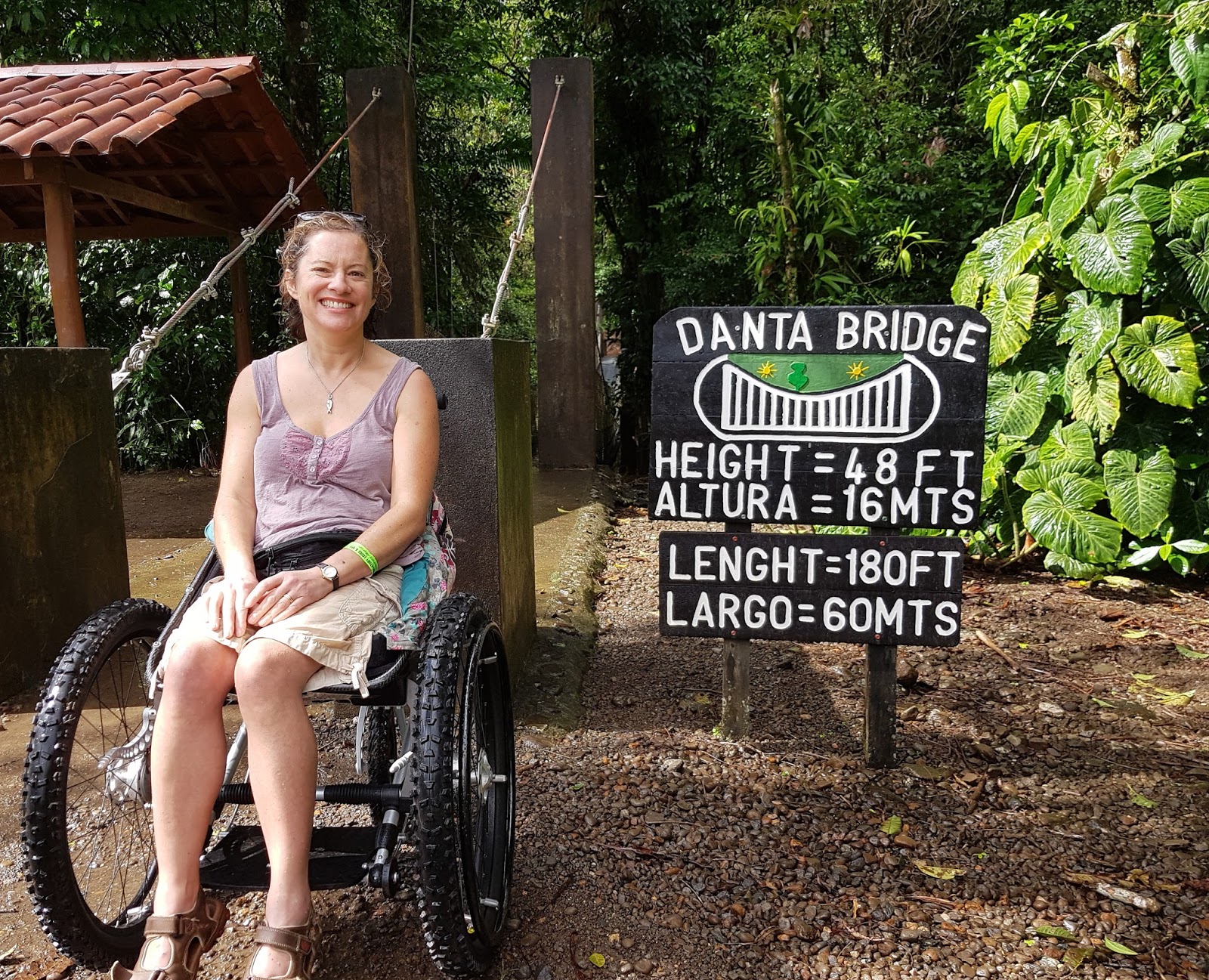
We've taken advantage of the Christmas holidays and all meet up with Louise in Costa Rica for two weeks. Fantastic to see the wonderful country we've heard so much about at last. So much wildlife! Spent the first few days near Arenal Volcano (not that the cloud ever cleared to give much of a view). Arenal Observatory Lodge includes some reasonably accessible trails for an all-terrain wheelchair like Mac and someone like myself able to walk short distances (currently up to about 100m or 5 minutes total standing time). As I've said so often before, there is a huge difference between being a wheelchair user and being wheelchair bound.


This was as far as I got while the rest of them legged it down steep and slippy steps to swim in the waterfall far below. I'd have been there in a former life and did consider trying to clamber down....


So if I look wet in the photos I hadn't been swimming it's because it rains (heavily) frequently in between spells of beautiful sunshine. Guess that's why it's called a rainforest.
Arenal Volcano is behind us!